New Cracks Appeared Over the Summer. Is It Subsidence?
If you have noticed a crack this month that you are sure was not there in the spring, you are not imagining it and you are not alone. Summer 2026 was the warmest the UK has ever recorded, and across the south and east of England the ground has spent months drying out. When clay soil dries it shrinks, and when it shrinks the house sitting on it moves. The cracks follow.
So the question most people are typing into Google right now is a simple one: is my house subsiding, or is this just the weather? This guide is written to answer that from a builder's point of view. It covers what a hot summer does to a house, how to tell a seasonal crack from one that matters, when it is sensible to wait and when it is not, and what each outcome is likely to cost.
If you want a quick first read on the crack in front of you, our crack severity checker grades it against BRE Digest 251, the scale surveyors and structural engineers use. It takes about two minutes and you only need a ruler or a coin.
Why so many cracks have appeared this year
The Met Office confirmed that summer 2026 was the UK's warmest on record, with a mean temperature of 16.5°C, 0.4°C above the previous record. England, Wales and Northern Ireland each set records of their own, and many areas had less than half their usual summer rainfall. At RHS Wisley in Surrey there were more than 60 days in a row with no measurable rain.
That matters because a large part of lowland England, and most of London, is built on shrinkable clay. Clay holds water the way a sponge does. Wet, it swells. Dry, it shrinks and cracks. The top metre or two of the ground, which is where most older houses have their foundations, goes through that cycle every year. In a normal summer the movement is small. In a summer like this one it is not.
The insurers are already seeing it:
- Record claim sizes. Figures from the Association of British Insurers show the average subsidence claim reached a record £20,000 in April to June 2026, up more than £2,000 on a year earlier, with £72m paid out in the quarter against £60m for the same period in 2025.
- A sharp rise in claims. Hastings reported subsidence claims up 140% year on year in August 2026 alone.
- A long-term trend. The British Geological Survey estimates that more than 1.8 million UK properties, around 5%, will be at risk from clay subsidence by 2070 on a medium emissions scenario, including more than a quarter of properties in London.
None of that means your crack is subsidence. Most cracks that open in a dry summer are seasonal movement, and many close up again once the autumn rain gets back into the ground. But it does explain why so many homeowners are looking at a wall they never worried about before.
Is my house subsiding, or is this seasonal movement?
Seasonal movement and subsidence start from the same cause: the ground under the house changing volume. The difference is whether the movement reverses. Seasonal movement opens in late summer and closes over winter. Subsidence keeps going in one direction, and the crack gets wider year after year.
You cannot always tell which one you have from a single look in September. But the crack usually gives you clues.
Signs that point towards seasonal movement:
- The crack is fine, hairline up to a millimetre or two.
- It appeared, or got noticeably wider, during a long dry spell.
- It is at a weak point in the building: above a door or window, around a bay, or where an extension meets the original house.
- It runs through the plaster or the mortar joints and not through the bricks themselves.
- Doors and windows still open and close as they did before.
Signs that point towards subsidence:
- The crack is wider than about 3mm, or wide enough to fit a 10p coin edge into it.
- It runs diagonally and is wider at the top than at the bottom. The ABI puts this first on its own list of warning signs.
- It shows on both the inside and the outside of the same wall.
- Doors and windows have started to stick or jam.
- Wallpaper is rippling or tearing where it crosses a wall junction, with no damp to explain it.
- The crack is still getting wider after the weather breaks.
One or two of the first list is normal for an older house after a summer like this. Several of the second, especially a tapering diagonal crack plus sticking doors, is worth acting on now rather than waiting.
For a fuller guide to telling the types of crack apart, including historic settlement and thermal movement, read cracks in walls: subsidence, settlement or thermal movement?
How to read the crack itself
Builders and engineers look at three things: how wide the crack is, which way it runs, and where it is.
Width
Width is the one number that matters most, and it is the basis of the BRE Digest 251 scale:
- Category 0 to 1 (up to 1mm): hairline cracks. Normal decoration will cover them.
- Category 2 (up to 5mm): easy to fill, may need some repointing outside. Doors and windows may stick slightly.
- Category 3 (5 to 15mm): needs opening up and repair. Drains and service pipes may be affected.
- Category 4 to 5 (over 15mm): structural repair, sometimes partial rebuilding.
Measure at the widest point and write the date down. A single measurement tells you the category. Two measurements a few weeks apart tell you far more, because they tell you whether it is still moving.
Direction
Horizontal and vertical cracks at weak points are often thermal or seasonal. A diagonal crack, especially one that steps up through the mortar joints of a brick wall, is a sign that one part of the building is moving relative to another. The direction of the taper tells you which part is dropping.
Location
Look at what is nearby. A crack at the corner of the house nearest a large tree, or where an extension joins the original building, is exactly where clay shrinkage shows up first. A crack beside a downpipe or a gully may point to a leaking drain washing out the ground, which is a different problem with a different fix.
Two real cracks that need more than waiting
These two photographs were taken on real jobs. Both are the kind of crack people put down to the hot summer and plan to fill in the spring. Neither should be treated that way, and they show why the look of a crack matters more than when you noticed it.
A stepped crack that has been filled before
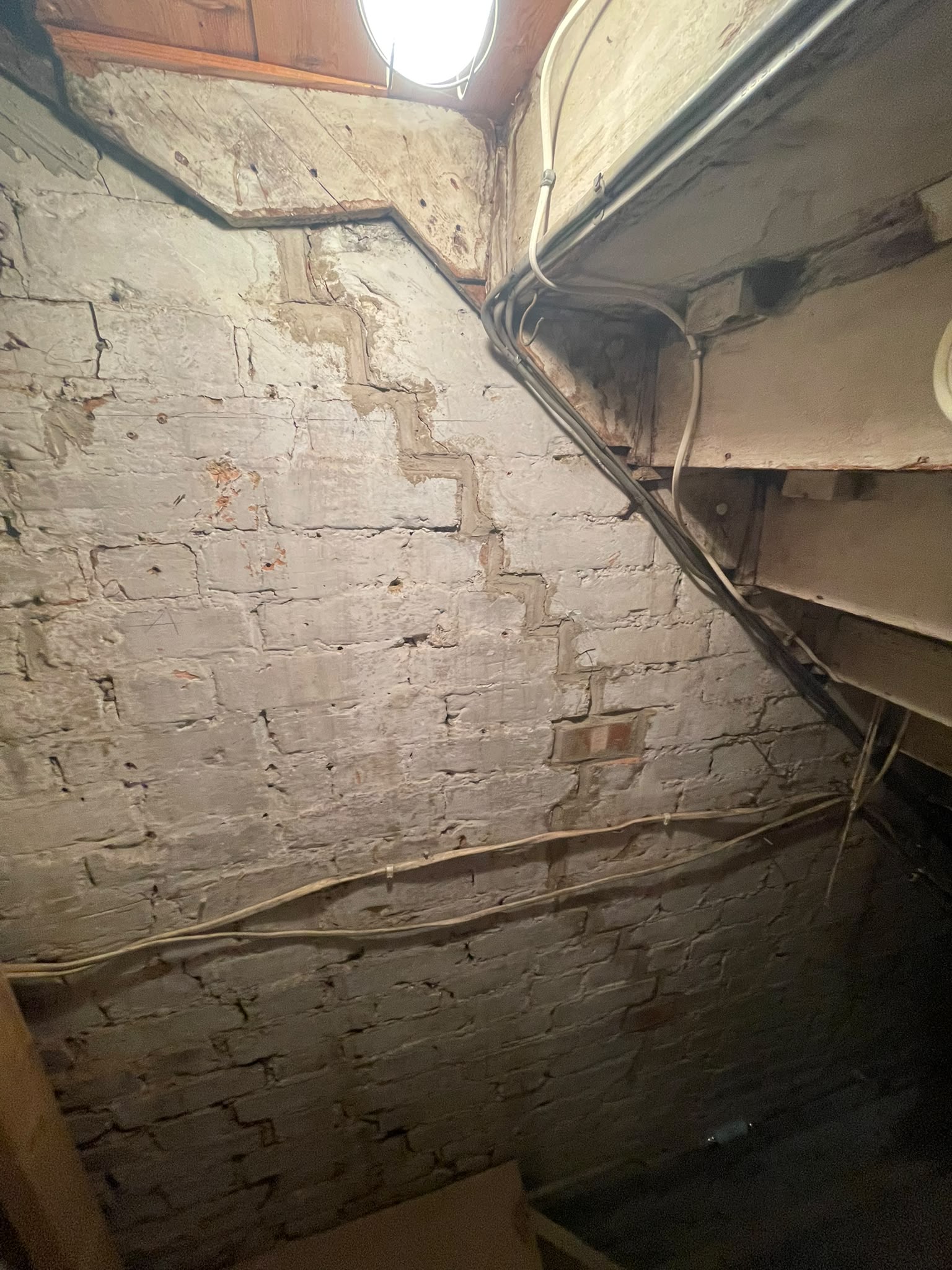
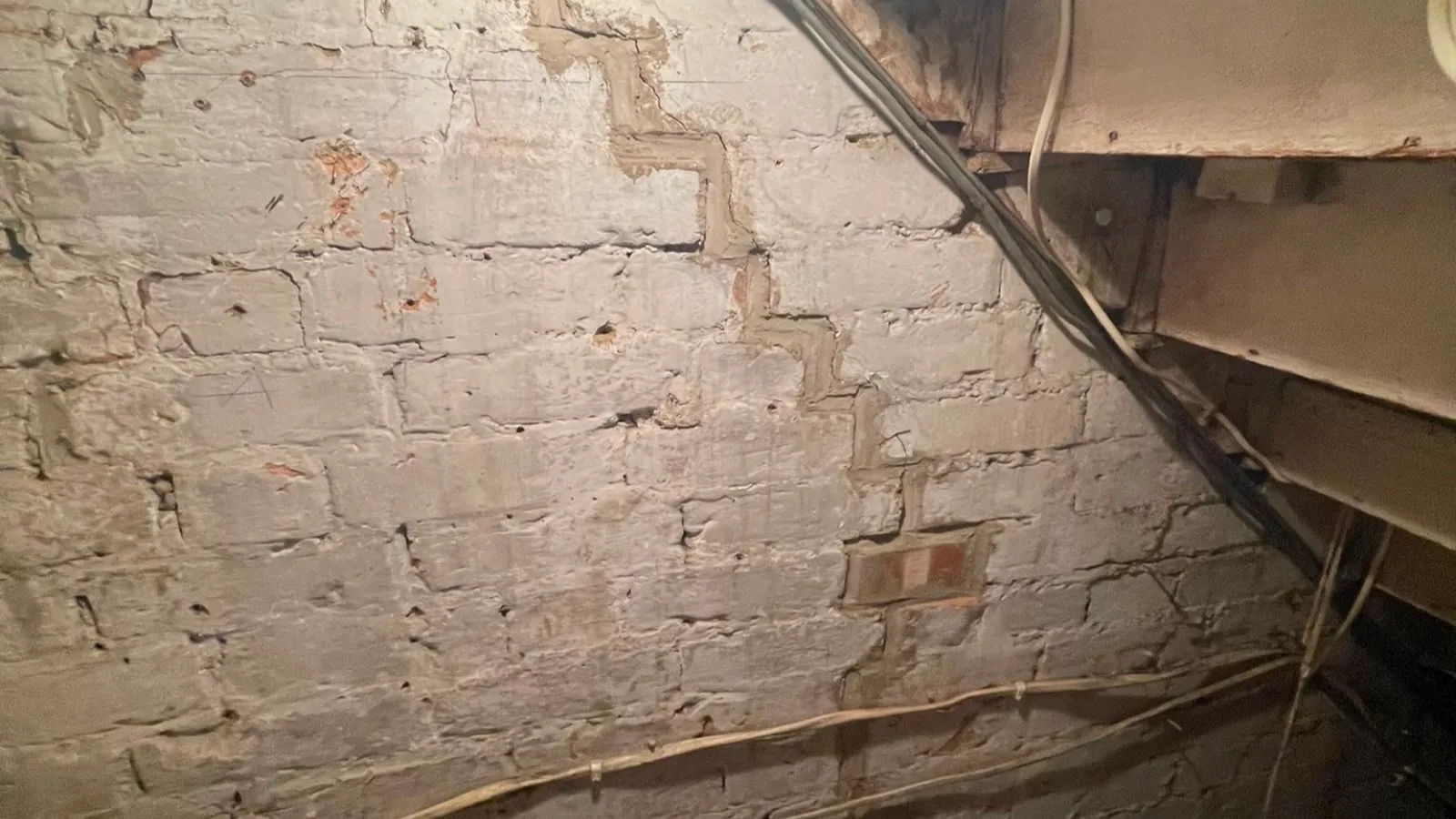
This is the painted brick wall under a staircase, with the underside of the stairs running across the top of the picture. The crack steps diagonally down through the mortar joints, following the horizontal bed joints and the vertical joints between bricks rather than splitting the bricks themselves. That stepped pattern is the classic sign of movement in a brick wall.
The detail that matters most is the pale mortar running along the crack line. That is an earlier repair. Someone has already filled this crack, and it has opened up again along the edges of their repair. There is also a patch of replaced brick lower down, and a scatter of finer cracks elsewhere in the wall. A crack that comes back through a repair is a crack that is still moving, and that is the most useful single piece of evidence you can have.
A seasonal crack can reopen once. A crack that has been filled and has opened again over several years is not something to fill again and forget. It needs monitoring through a full winter and, if it keeps widening, a structural engineer's opinion.
A vertical crack you can see into
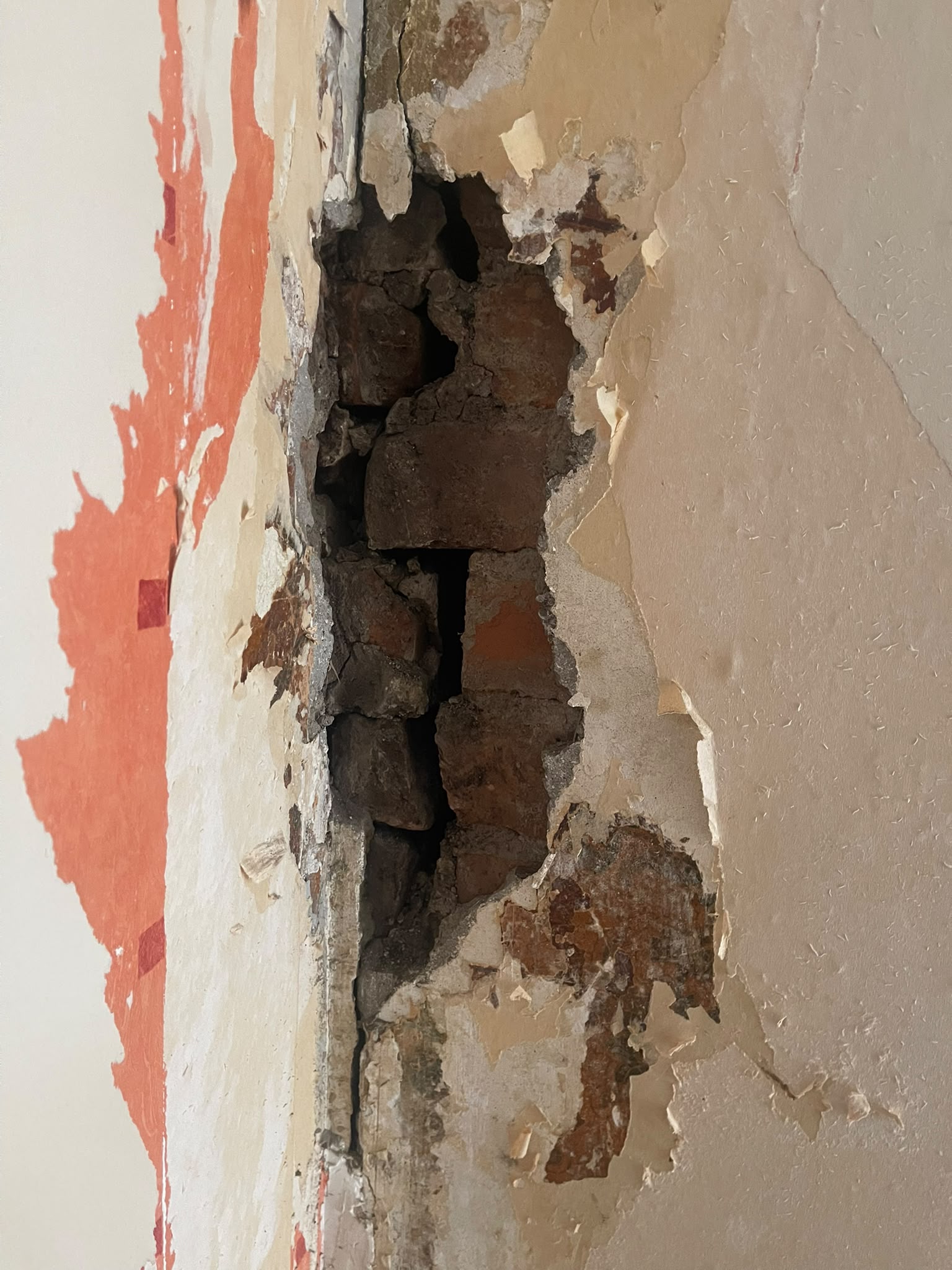
From the room, this started as a straight vertical crack in the wallpaper. With the paper and plaster taken off, it is a different story. There is an open gap running down through the brickwork, deep enough to see into, and several bricks along its edges are cracked and loose.
A straight vertical crack like this often sits at a junction: where two walls meet without being properly bonded or tied together, or where an old doorway or opening was filled in. The two sides move independently, and over time the joint between them opens up. A dry summer can make that worse, but it is rarely the whole cause.
Two lessons from this one:
- The wallpaper hides the size of the problem. A hairline crack in the paper can sit over a gap in the masonry many times wider. If a crack keeps reappearing in the same place, it is worth taking the finish off to see what is behind it.
- A crack that goes right through the wall is not cosmetic. Filling the plaster will not reconnect the brickwork. The fix usually means opening it up, stitching or tying the two sides back together, and finding out why they separated in the first place.
If you are not sure, ask a builder before you spend anything
This is the point where most people either do nothing or panic and call in expensive help. There is a cheaper step in between.
Send us photos, a short description and how long the crack has been there through a £59 builder review. A working builder writes back within 24 hours and rings you to talk it through: whether it looks seasonal, whether to monitor it and how, or whether it needs an engineer. That can save you an unnecessary £1,000 report, or stop you sitting on a crack that should not wait.
Should you wait until winter?
For a fine crack that appeared during the dry spell and shows none of the warning signs above, waiting is often the right call. Autumn rain gets back into the clay, the ground swells again, and many seasonal cracks close up partly or fully by spring. Filling one now just means the filler cracks again next summer.
Waiting does not mean ignoring it. Monitor it properly:
- Mark the ends. A fine pencil line across each end of the crack, with the date written beside it, shows at a glance if it has grown.
- Measure the width at the same point every few weeks, and write it down.
- Take a dated photo from the same position each time, with a ruler or coin in the shot.
- Fit a tell-tale. A cheap plastic crack monitor fixed across the crack gives a reading to a fraction of a millimetre.
If you want this done professionally, level and crack monitoring by an engineer or surveyor usually costs £300 to £800 over several months, and it produces the kind of record an insurer will take seriously.
Do not wait if:
- the crack is wider than about 5mm, or is getting wider week by week
- doors or windows have started jamming
- the crack runs through the bricks rather than around them
- there is rust staining coming through, or the crack runs along the line of a lintel
- you can see into the crack, or it goes right through the wall
- you have a leaking drain or a soggy patch of ground near the crack
- you are about to exchange contracts on the property
The tree trap: do not cut it down yet
Trees are the single biggest driver of clay shrinkage near houses. A mature oak, willow or poplar can draw water from the ground a long way from the trunk, and in a dry summer its roots dry the clay out under your foundations.
The obvious answer looks like cutting the tree down. On clay that can make things worse. Remove a large tree that has been drying the ground for decades, and the clay slowly takes the water back, swells, and pushes the house upwards. That is called heave, and it can do as much damage as the shrinkage it replaced, sometimes over several years.
So the sequence matters:
- Get advice before any tree near the house is felled or heavily cut back.
- Check with the council whether the tree has a Tree Preservation Order or you are in a conservation area.
- If it is causing the movement, controlled management or a root barrier is often the better answer. Tree management or a root barrier typically costs £500 to £4,000 depending on the tree and access.
If the tree is on a neighbour's land or the street, speak to your insurer before you approach anyone. If it becomes a claim, the insurer can deal with the tree's owner directly.
What it costs if it is subsidence
If the crack does turn out to be subsidence, the costs are usually lower than people fear. The figures below are the ones we use across the site:
- Structural engineer's report: £500 to £1,500. See what a structural engineer's report costs and covers.
- Crack and level monitoring: £300 to £800 over a few months.
- Tree management or root barrier: £500 to £4,000.
- Crack repair once movement has stopped: £500 to £3,000, including stitching and repointing.
- Underpinning, localised: £8,000 to £20,000.
- Underpinning, full: £25,000 to £60,000 or more.
Underpinning is the number that frightens people, and it is rarely needed. According to RICS, fewer than 10% of confirmed subsidence cases end up needing it. Most are dealt with by removing the cause, whether that is a tree or a leaking drain, waiting for the ground to settle, and then repairing the cracks. Our guide to underpinning costs and when you actually need it goes through this in detail.
To put rough numbers on any repair, the survey repair cost calculator gives a range for each item.
Should you tell your insurer?
If you think the crack could be subsidence, yes. Buildings insurance normally covers subsidence, usually with a higher excess than other claims, commonly £1,000. Insurers expect to be told early, and a claim goes more smoothly when you have dated photos and measurements to hand.
Telling your insurer about a crack is not always the same as making a claim, but it may still need declaring when you renew or sell. The details are in does subsidence affect your home insurance?
Buying a house this autumn?
If you are buying, the timing of your survey matters this year. A survey done in September or October sees cracks at their widest, so expect more of them in the report than you would in spring. That is not automatically bad news, but it means the surveyor's wording needs reading carefully.
A crack flagged as "possibly seasonal" with a recommendation to monitor is very different from one flagged for a structural engineer. If the survey recommends further investigation, the seller should allow it before you exchange, and you can use the survey repair cost calculator to see what the findings might cost before you negotiate.
Talk it through with a builder
Most cracks after a summer like this one are nothing to lose sleep over. A few are, and the difference is not always obvious from inside the house.
- Ask a builder one question. Free, a reply within 24 hours, no card and no catch. Send a photo and we will tell you whether to monitor it, fill it, or get an engineer in.
- Get builder advice about your cracks. £59 for a proper conversation about your property, with a call within 24 hours and a money-back guarantee.
Either way, you will know what you are dealing with before you spend money on it.
Frequently asked questions
Are cracks after a hot summer normal?
Fine cracks are common after a long dry summer, especially in older houses on clay soil. The clay shrinks as it dries and the house moves slightly with it. Most of these cracks are hairline to a millimetre or two, appear at weak points such as above doors and windows or where an extension joins the house, and partly close again once autumn rain gets back into the ground.
How wide does a crack have to be before I should worry?
As a rough guide, cracks up to 1mm are cosmetic and cracks up to 5mm are usually easy to repair. Anything wider than about 3 to 5mm, a diagonal crack that is wider at the top, or a crack that is still growing after the weather breaks is worth getting looked at. Doors or windows that have started to stick at the same time are another reason to act.
Will the cracks close up over winter?
Seasonal cracks caused by clay shrinkage often close partly or fully between autumn and spring as the ground takes up water again. Cracks caused by ongoing subsidence, a leaking drain or rusting steel in the wall will not. Measuring the crack and marking its ends through the winter is the simplest way to find out which you have.
Should I fill the crack now?
Usually not yet. If the crack is seasonal, filler put in now will crack again next summer, and it hides the evidence you need for monitoring. Measure it, mark the ends, take dated photos, and repair it once you know it has stopped moving, typically after a full winter.
The crack was filled before and it has come back. What does that mean?
A crack that reopens through an earlier repair is still moving, which is the most useful single piece of evidence you can have. It may be seasonal movement that repeats every summer, or it may be progressive. Either way, do not just fill it again. Monitor it through a winter and, if it keeps widening, get a structural engineer's opinion.
Does a crack mean my house will need underpinning?
Very rarely. According to RICS, fewer than 10% of confirmed subsidence cases need underpinning. Most are resolved by dealing with the cause, such as a thirsty tree or a leaking drain, letting the ground stabilise, and then repairing the cracks, which typically costs £500 to £3,000.
Should I cut down the tree near my house?
Not without advice. On clay soil, removing a large established tree can let the ground swell back up and push the house upwards, which is called heave and can cause as much damage as the original shrinkage. Check for a Tree Preservation Order, get advice first, and consider management or a root barrier, typically £500 to £4,000.
Work it out yourself
Free tools built on real 2026 builder rates. No sign-up, no email.